- Se connecter pour publier des commentaires
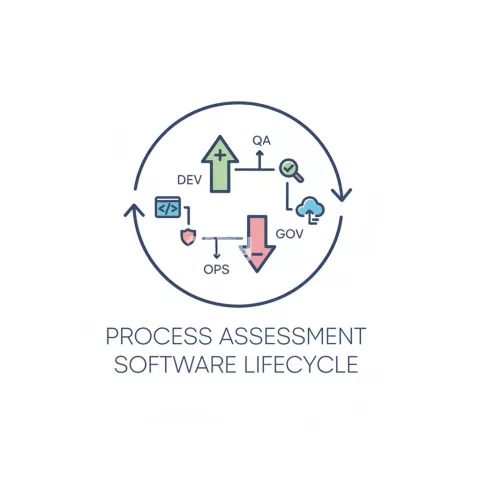
The process assessment evaluates how the application is developed, delivered, and maintained, highlighting strengths and weaknesses in the software development lifecycle, quality assurance, operations, and governance.
During the process assessment, following key dimensions are reviewed:
Software Development Lifecycle (SDLC)
Methodology in place (Agile, Scrum, SAFe, Kanban, Waterfall, hybrid).
Requirements management (clarity, traceability, alignment with business goals).
Change prioritization and backlog management.
Collaboration between business and IT stakeholders.
Delivery & Release Management
Predictability and frequency of releases.
CI/CD pipeline maturity and level of automation.
Deployment practices (manual vs automated, blue/green, canary).
Lead time for changes and change failure rates.
Quality Assurance & Testing Processes
Test strategy and coverage across all levels (unit → system).
Degree of test automation and integration with pipelines.
Defect management (reporting, severity classification, resolution).
Continuous feedback loops (test results → improvements).
Operations & Incident Management
Monitoring, alerting, and observability processes.
Incident handling efficiency (MTTR, escalation, root cause analysis).
Problem/change management practices (alignment with ITIL if relevant).
SLA/SLO adherence and reliability engineering practices.
Collaboration & Knowledge Management
Communication between developers, operators, QA, and business.
Retrospectives and continuous improvement loops.
Documentation quality (runbooks, onboarding, wikis).
Tooling ecosystem (Jira, Confluence, Slack/Teams, etc.).
Governance & Compliance Processes
Decision-making speed and transparency.
Risk management integration in delivery.
Compliance with security and regulatory requirements.
Auditability and traceability of changes.